Strategy task
A projection contains the schedule of work required to manage the asset through its life cycle, and the costs associated with that work. AMT breaks down an asset’s cost projection to the component level. The type of work performed on a component and its cost are defined in a strategy task.
You can create a strategy task by navigating to
- Setup & Admin > Projections > Strategy Task Manager , applying the relevant filters then clicking the Add icon.
- Setup & Admin > Projections - Multi-editors > Copy Strategy Tasks.
You can also get to these windows by navigating to
- Centrelines > Administration.
- Modelling > Administration > Projections.
An AMT strategy task is a specific maintenance task that is forecast to occur periodically over the life cycle of the asset. At this level you are able to identify:
- costs to perform work on components, services and so on.
- type and frequency of work that will be required.
- parts and labour required.
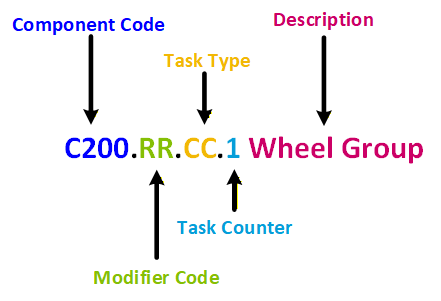
Both strategy tasks and work orders are uniquely defined by a combination of four codes:
- Component Code (CC)
What is being worked on or forecast (for example, HCYL – Hoist Cylinder). - Modifier Code (MC)
Used to provide an additional identification to the component code (such as the component's location on the machine, for example, right, left, upper and so on.). - Task Type (TT)
A code and description combination that identifies what is to happen at an occurrence of the task (for example, CC – component change out, GR – general repair). - Task Counter (TC)
Defines the sequence by which a task is performed, for example:- C220.RR.CC.1 (First/Freq 15,000 until 30,000hrs) reflects a remanufacturer strategy.
- C220.RR.CC.2 (First 45,000hrs Freq. 15,000) reflects a rebuild strategy.
Most Tasks do not use the Task Counter. It will be set to zero, for example, C200.RR.CC.0.
Strategy Task Structure
The structure of a strategy task in a projection is pictured below.
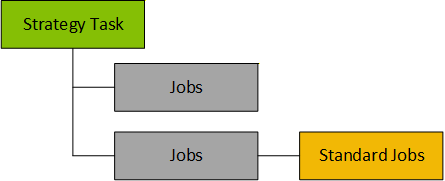
Each strategy task can have one or more strategy task jobs and each job has a cost, which is split into parts, labour and miscellaneous. You can manually enter the costs into each of these categories, or you can link the job to a standard job.
Strategy tasks can represent a variety of activities:
- Component changeouts
- PM services
- Inspections
- General repairs
- Unscheduled/miscellaneous work (that is, provision for costs)
Strategy tasks that are contained in the current projection are repetitive strategic maintenance activities, which typically require
- Budgeting
- A maintenance strategy
- Standard jobs
- Part, rotable component and costs to be forecast.
- Long-term planning (for example, in order to consider lead times)
- Short-term planning (for example, resources, location, support assets)
Strategy task modes
You can create a task in normal or unassigned mode. Below are examples of normal and unassigned task mode structures. Unassigned tasks have the same structure as simple mode tasks but have some limitations. Below is a summary of the characteristics of each task mode:
Normal
- Can be a planning task or a non-planning task.
- Can use advanced scheduling logic.
- Can be associated with a rotable part.
- Can have a rotable repair strategy.
- Can have jobs and therefore multiple currencies in cost build up.
- Can link to multiple standard jobs (if the task has multiple jobs).
Standard jobs can only be linked if the standard job module of AMT has been implemented. You should refer to the Standard Jobs Overview for more information.
You must consider the above characteristic before creating a task in the projection. It is not possible to swap or change between task modes after the task has been created.
Unassigned
- Can only be a non-planning task.
- Cannot use advanced scheduling logic.
- Cannot be associated with a rotable part.
- Cannot have a rotable repair strategy.
- Cannot be linked to a standard job.
Unassigned is a strategy task mode to:
-
Budget for general repair costs at the subsystem level, to complete a full lifecycle costing model.
-
Group actual costs for non-strategy tasks into subsystems for high-level cost reporting.