Aggregated evaluation
Aggregated evaluation is a special aggregation type for calculated fields. Instead of applying an expression at the slice level and then rolling up the results, the expression is evaluated at the level where the field is displayed or reported (e.g., activity area, report, or material grouping).
Process
Standard aggregation
With standard aggregation, the expression is applied to each slice and then aggregated up.
Consider a field named CalculatedSumDensity, which determines the record’s density using the Sum aggregation type. The expression used is Density + 1.
The expression references the default Density field and adds 1 to it.
If there are 20 slices with a density of 1.7, the result for the associated activity area is 54.
Aggregated evaluation
Wirth aggregated evaluation, the expression is applied once at the given level where the field is displayed or reported.
Consider a field named CalculatedEvaluationDensity, which determines the record’s density using the Aggregated Evaluation type. The expression used is also Density + 1.
If there is one activity area with a density of 1.7, the result of the field expression is 2.1 because it’s done at the activity area level.
Visual

|
Activity area spanning one block model block – and one material
|
Activity area spanning multiple blocks and multiple materials
|
||||||||||||||||||||||||||||||||||||||||
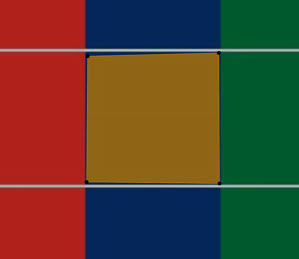
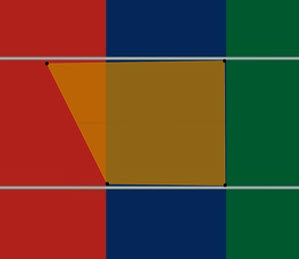
This visual shows two instances of an activity area (MINEFe_003) within the block model. Each square represents a block of the block model, and the legend colours each block according to its predominant material. For the activity area in each instance, its principal field values—including the sum and aggregated evaluation density—are shown. The visual shows the result of these fields when the activity area has different sizes and crosses blocks with different materials.
Additional example
Looking at this alternative view, of an activity area’s slices spanning multiple blocks…
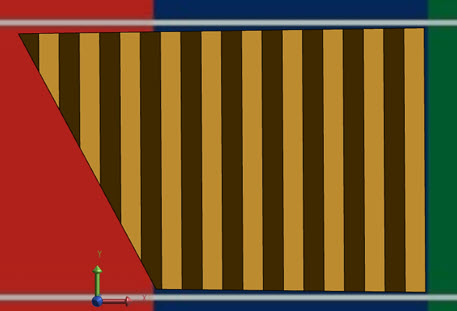
The red block contains OBWaste (with a density of 1.50), and the blue block contains OBFe (with a density of 1.70).
14 slices intersect the blue (OBFe) block, and 7 slices intersect the red (OBWaste) block. In this case:
|
Material |
Field |
Result |
|---|---|---|
|
OBWaste |
CalculatedSumDensity |
(1.5 + 1) * 7 = 17.5 |
|
OBFe |
(1.7 + 1) * 14 = 37.8 |
|
|
OBWaste |
CalculatedEvaluationDensity |
Density + 1 |
|
OBFe |
||
|
All (combined) |
CalculatedSumDensity |
17.5 + 37.8 = 55.3 |
|
CalculatedEvaluationDensity |
(1.66 + 1) = 2.66 |
Report summary – all materials
|
Activity Area |
Density |
Calculated Evaluation Density |
Calculated Sum Density |
|---|---|---|---|
|
MINFe_003 |
1.6612 |
2.6612 |
55.3 |
Report summary – by material
|
Activity Area |
Material |
Density |
Calculated Evaluation Density |
Calculated Sum Density |
|---|---|---|---|---|
|
MINFe_003 |
OBFe |
1.7 |
2.7 |
37.8 |
|
OBWaste |
1.5 |
2.5 |
17.5 |
These same results are reflected in all outputs—including when the Material level is and isn’t included the output—such as Data Feed Out publish plans, request designs, and published activity areas.